The final week of my CEP program we reflected on our practice. How do we bring passion and curiosity to our students? How can we incorporate technology to instill passion and curiosity? The infographic below is how I chose to represent my information. It focuses on how technology is used from a student and from a teacher perspective.
From a teaching perspective, I focus on generating real-world problems. Which often means researching related topics and preparing multiple scenarios for students to explore. For example, I teach a lesson on tweets or youtube videos going viral. Students must determine how long it takes or how quickly content must be shared in order for it to become viral. Students take this questions, research it further, collaborate and assess each other’s ideas to further thinking, then submit their responses. If these responses are submitted or shared electronically, it is much easier to keep an ongoing log of student-student or student-teacher ideas for revision. By using these technologies, we are able to generate more passion and curiosity towards the topics we learn as well as improve on skills needed in today’s global and technologically advanced society.
Education, it seems, has always been pivotal in the advancement of the next generation of society. Children were apprenticed to craftsmen, artisans, clergy, etc. as they trained to become a member of that society. The problem with this form of apprenticeship allowed only certain individuals the opportunity to train, especially in poor environments. Public education addressed this complex problem in providing the same information to all attendees. The idea being that with an equal informational starting point, society creates a more level playing field for all of its citizens. Now, however, there seems to be a new shift in thinking. Intelligence is no longer being defined as what facts you know, but how you are able to collaborate, analyze, and problem solve (Gee, 2013). Gee presses for a shift to a passion-centered learning similar to an apprenticeship with one caveat: with technology, people can choose their passion. According to James Gee, “affinity spaces are locations where groups of people are drawn together because of a shared, strong interest or engagement in a common activity” (2004). Instead of having one “master” teacher skills are passed on in a “social mode of production” where many people pass on information. “Some one who knows a little more passes on information to someone who knows a little less” (Jenkins, 2011). In this way, there is opportunity for people to meet as equals yet still learn collectively about their passion.
To be involved in online affinity spaces,
people must have access to the internet, something many of my students still lack,
they must have the drive to garner new information about their passion
they must be aware of the multiple sources of information and opinion.
So Gee and Jenkins both discuss this amazing online phenomenon of the Mind where we can collectively have a voice and make a difference. But we are still not fully represented online and those of us who are online, are slowly enmeshing ourselves into singular viewpoints where we are only getting snippets of information that agree with views we already hold and provide no deeper thought, (Carr, 2011). It is very easy to put blinders on and become unaware that there exists opinions vastly different from one’s own.
Limits of an Individualized Infodiet
Image created by Cottrell, A. (n.d.)
The task we were given this week was to find three sources, including a new Twitter or RSS feed, that had a differing opinion on our CEP problem. This was extremely difficult! Each site I logged into gave me options like “recommended for you” or “stories you may like”. There wasn’t really a place that said “differing opinions from those you usually post and access.” I eventually had to search for articles by specifically typing in things like “people against internet in the classroom” and “why is collaboration in the classroom bad?” and then follow people listed as persons of interest in those sites. While one of the pedagogies I follow is to teach students to collectively work together or with others to solve problems, there is an entire group of educators and students who feel that silent, structured settings work better for many students to learn – which is after all the goal of education. (Godsey, 2015). Godsey’s school of thought is to have students only work individually. Like golf, their goal is to always improve their own work.
The other two sources I found didn’t necessarily have different opinions, they did have ideas I was not aware people were bringing up online. Things about travel and its affect on education or playing with legos followed ideas I had discussed with other educators on the path of globalization and gamification. I had not had much access to specific content in regards to these ideas. It makes sense that there are people out there trying to be heard in regards to these general ideas. Without expanding my own infodiet, I would never have had the opportunity to push my thinking. I had not realized that my infodiet blocked not only different opinions, but also ideas that I may agree with but in which I had not expressed a specific interest.
Gee, J. P. (2004). Situated Language and Learning: A Critique of Traditional Schooling. New York. Routledge.
Godsey, M. (2015). When Schools Overlook Introverts. The Atlantic Monthly Group. Retrieved from: http://www.theatlantic.com/education/archive/2015/09/introverts-at-school-overlook/407467/
History of Apprenticeship. Washington State Dept. of Labor & Industries. Retrieved from: http://www.lni.wa.gov/TradesLicensing/Apprenticeship/About/History/
Jenkins, H. (2011). Media Scholar Henry Jenkins on Participatory Culture and Civic Engagement. Retrieved from: https://www.youtube.com/watch?v=ZgZ4ph3dSmY#t=104
Cotrell, A. (n.d.). Image retrieved from: https://1.bp.blogspot.com/-B1mFBSSPElQ/VIYAehF1OOI/AAAAAAAAAC8/HoKngzkW4NU/w800-h800/info%2Bdiet%2B1.png
A wicked problem is a problem that is difficult or impossible to solve because of incomplete, contradictory, and changing requirements that are often difficult to recognize. The use of term “wicked” here has come to denote resistance to resolution. – Wikipedia
There is an ever increasing disparity between the skills we expect students to have and those they have actually mastered. Citizens today are expected not only to be technologically literate, but also be able to use the information technology offers to assess and analyze problems. The wicked problem here is asking how we can rethink the roles of educators to fully prepare students emerging into society. The infographic below explains this problem more fully.
To think about this problem further and analyze possible solutions, I met with two colleagues over the course of three weeks within our class at MSU on Applying Educational Technology to Practice. You can find the blogs related to my colleague’s educational practices and rethinking teaching here (Lindsey) and here (Brett). After discussing many solutions including project-based learning, educational and professional development opportunities and strategies, and cross-curriculum teaching (the fact that there are many potential solutions and any or all could be beneficial or not depending on their implementation is another aspect of this problem’s “wickedness”), we finally settled an a three-tiered solution.
Create student-centered classrooms
Implement project-based learning
Utilize technology appropriately
While each of these could be a solution on its own, we tried to focus on using these three things in conjunction in order to have maximum impact on broadening student skills.
You can read further about our solution in the white paper linked below.
“Since time immemorial, people have been transferring skills from one generation to another in some form of apprenticeship. Four thousand years ago, the Babylonian Code of Hammurabi provided that artisans teach their crafts to youth.” – Washington State Dept
Education, it seems, has always been pivotal in the advancement of the next generation of society. Children were apprenticed to craftsmen, artisans, clergy, etc. as they trained to become a member of that society. The problem with this form of apprenticeship allowed only certain individuals the opportunity to train, especially in poor environments. Public education addressed this complex problem in providing the same information to all attendees. The idea being that with an equal informational starting point, society creates a more level playing field for all of its citizens. Now, however, there seems to be a new shift in thinking. Intelligence is no longer being defined as what facts you know, but how you are able to collaborate, analyze, and problem solve (Gee, 2013). Gee presses for a shift to a passion-centered learning similar to an apprenticeship with one caveat: with technology, people can choose their passion. Instead of having one “master” teacher skills are passed on in a “social mode of production” where many people pass on information. “Some one who knows a little more passes on information to someone who knows a little less” (Jenkins, 2011). In this way, there is opportunity for people to meet as equals yet still learn collectively about their passion. This actually coincides quite nicely with the complex problem my group in CEP812 is researching: tentative title: Rethink Teaching: Preparing Students for a Globalized World.
Jenkins and Gee both refer to people who participate in games (Gee) or are passionate about anime or play dungeons and dragons (Jenkins). Their examples include things like Harry Potter, The Sims, and Call of Duty. The majority of students are not involved in this online culture. Many share experiences via social media, but few meet the nerd-like criteria Jenkins and Gee seem to take for granted. To be involved in online learning centers,
people must have access to the internet, something many of my students still lack,
they must have the drive to garner new information about their passion
they must be aware of the multiple sources of information and opinion.
So Gee and Jenkins both discuss this amazing online phenomenon of the Mind where we can collectively have a voice and make a difference. But we are still not fully represented online and those of us who are online, are slowly enmeshing ourselves into singular viewpoints where we are only getting snippets of information that agree with views we already hold and provide no deeper thought, (Carr, 2011).
The task we were given this week was to find three sources, including a new Twitter or RSS feed, that had a differing opinion on our CEP problem. This was extremely difficult! Each site I logged into gave me options like “recommended for you” or “stories you may like”. There wasn’t really a place that said “differing opinions from those you usually post and access.” I eventually had to search for articles by specifically typing in things like “people against internet in the classroom” and “why is collaboration in the classroom bad?” and then follow people listed as persons of interest in those sites. It was much more work than I expected. If it was difficult for me, someone actively seeking an alternate opinion, how much worse is it for those who are not aware that there are more ideas out there?
The things I learned from this exercise:
It is very easy to put blinders on and become unaware that there exists opinions vastly different from one’s own.
While one of the solutions I offer in the problem of “Rethink Teaching” is to teach students to collectively work together or with others online to solve problems, there is an entire group of educators and students who feel that silent, structured settings work better for many students to learn – which is after all the goal of education. (Godsey, 2015). More research must be done in order to fully express a solution to this problem.
References:
Washington State Dept. (n.d.). History of Apprenticeship. Washington State Dept. of Labor & Industries. Retrieved from: http://www.lni.wa.gov/TradesLicensing/Apprenticeship/About/History/
Jenkins, H. (2011). Media Scholar Henry Jenkins on Participatory Culture and Civic Engagement. Retrieved from: https://www.youtube.com/watch?v=ZgZ4ph3dSmY#t=104
Godsey, M. (2015). When Schools Overlook Introverts. The Atlantic Monthly Group. Retrieved from: http://www.theatlantic.com/education/archive/2015/09/introverts-at-school-overlook/407467/
As the modern world progresses and technology becomes a more integral part of society’s identity, one must ask the question: How are schools handling this change? We know schools are purchasing technologies. As this shift towards technology occurs, businesses are starting to look for a new set of skills. What are these technology based skills employers seek? Are educators implementing technology in such a way as to benefit these skills businesses are looking for?
Side-by-side comparison of a business meeting and a classroom with technology.
This week I polled my school’s staff of 104 to see their take on how important technology is in teaching the next generation of students. Also, are we able to show students skills and proper use of technology? I found that most teachers do see technology as the future and they recognize the need for educators to learn new skills towards this implementation of technology. The results seem to point towards a point made by Gee in his book, The Anti-Education Era. We have many tools, and most people think those tools are necessary to success in modern society. However, these tools are “separated from, rather than blended with, face-to-face interactions, physical spaces, and deep educational uses that go beyond education” (pg 198). You can further read about my findings here.
References:
Gee, J.P. (2013). The Anti-Education Era. New York, NY: St. Martin’s Griffin.
In education we try to foster students who stand apart from the crowd of traditional educational models. We want students who are capable of speaking out on topics with confidence and well founded facts. We want students to be capable of having their own ideas.
We talk about free thinkers and the importance of individuality, creativity, and progress. We are drawn to innovative ideas and progression of society. As educators, we seek to foster creative and innovative thinking and problem solving within our students. However, educators often struggle in the motivation of groups of students and their seemingly unwillingness to tackle new problems. According to James Paul Gee in his book The Anti-Education Era, there are many reasons humans don’t take steps of logic in problem solving. Today, I am focusing on Chapter 7 from Gee’s book: Pitfalls Along Our Search for Status and Solidarity.
There are certain steps that must be met in order for a person to achieve the capability to make innovative additions to society. The fifth condition of smart human action is “the opportunity to act” (Gee, pg 14). This opportunity stems not only from the environment, but also in a person’s mental capability. I am not referring to IQ or a person’s inherent intelligence, rather the stability of the human mind in allowing for strongly rational decisions to be made.
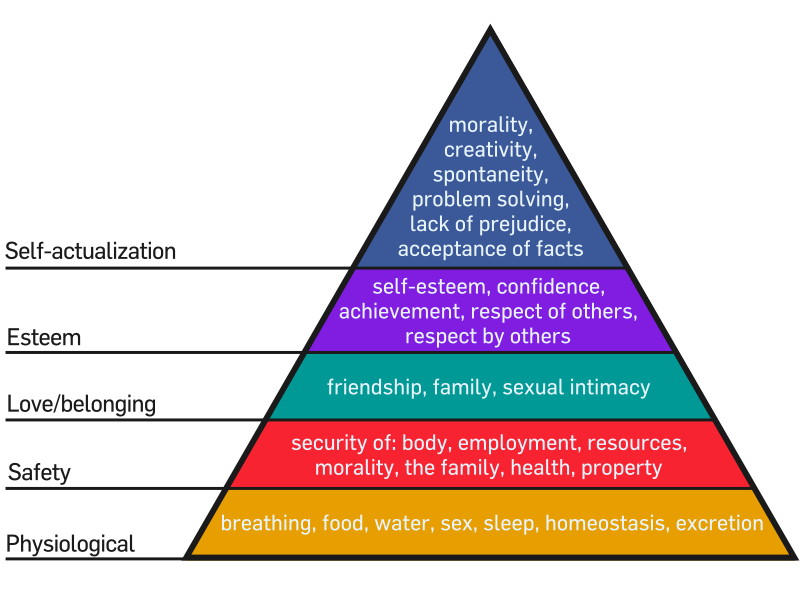
Maslow’s Hierarchy of Needs “Psychologist Abraham Maslow in 1943 posited that humans have a hierarchy of needs, and it makes sense to fulfill the basic needs first (food, water etc.) before higher-order needs can be met” (Wikipedia).
Following this model from the Wikipedia page on human psychology, we can see that after the basics of food, water, and a secure environment, the next human need is belonging. My paper focuses on Gee’s take on a person’s need to belong and how that need can often overrule logic in the decision making progress. The paper focuses on a human’s drive for status and solidarity and how that has specifically impacted my classroom. It also takes a look at how teachers, specifically myself, can work with these human drives to garner a stronger learning environment.
Teaching in a classroom in downtown Lansing, I am often working with students who speak or are learning to speak English as their second, or even third or fourth, language. The problem that I face and I am sure many math teachers face is differentiating instruction in such a way that the math content is not lost in translation. Too often I see students who have been taking math classes for many years, not understanding math topics. They get to the end of their education and while they have usually grasped the basics of the English language by this point, they struggle with basic math concepts. The problem: how do we teach content and good strategy for learning math to students who are still learning our language?
This problem is considered a “wicked problem” because there is no correct solution. Each teacher, each classroom, will have different ideas on how to address the issue of working with students who may or may not grasp mathematical concepts. According to the research I performed, “Students of all abilities learn best when they are placed within the same regular classroom that offers a challenging curriculum…Children creatively adopt for later independent use the strategies and skills evidenced in the social plane” (Eun, 2016). Even if a student is not learning the specific goal of the day, if they can still interact with people who are, they can learn to recognize different strategies of learning and study for when they are capable of understanding the content in the given language.
The free app that I researched in regards to this problem is called Photomath, a tool I had never heard of until taking CEP812. Photomath allows students to capture images of problems with their phone or a tablet and gives students the answers to those problems. One might be confused at this point. “Give students answers?” One might ask. Photomath is actually a great tool for all students as they practice to check their work. I believe it is especially helpful in presenting content to ELL (English Language Learners) for many reasons.Students who are struggling with the language can still learn concepts and skills. With a tool that takes students through problems step-by-step and using proper terminology to do so, students have a handy way to practice problems without constant hovering from a teacher or aide. Photomath is like having a carry-along tutor. While the app is really only good for straightforward equations, not word problems or graphing, it still can help students better visualize step-by-step configurations. It also keeps students practicing with the correct words associated with each step. Lastly, it can help students practice independently.
Check out this screencast I created about using Photomath to help address this problem.
References
Eun, B. (2016). The culturally gifted classroom: A sociocultural approach to the inclusive education of english language learners. Educational Psychology in Practice,32(2), 122-11. doi:10.1080/02667363.2015.1116060
Teaching in a classroom in downtown Lansing, I am often working with students who speak or are learning to speak English as their second, or even third or fourth, language. The problem that I face and I am sure many math teachers face is differentiating instruction in such a way that the math content is not lost in translation. Too often I see students who have been taking math classes for many years, not understanding math topics. They get to the end of their education and while they have usually grasped the basics of the English language by this point, they struggle with basic math concepts. The problem: how do we teach content and good strategy for learning math to students who are still learning our language?
This problem is considered a “wicked problem” because there is no correct solution. Each teacher, each classroom, will have different ideas on how to address the issue of working with students who may or may not grasp mathematical concepts. According to the research I performed, “Students of all abilities learn best when they are placed within the same regular classroom that offers a challenging curriculum…Children creatively adopt for later independent use the strategies and skills evidenced in the social plane” (Eun, 2016). Even if a student is not learning the specific goal of the day, if they can still interact with people who are, they can learn to recognize different strategies of learning and study for when they are capable of understanding the content in the given language.
The free app that I researched in regards to this problem is called Photomath, a tool I had never heard of until taking CEP812. Photomath allows students to capture images of problems with their phone or a tablet and gives students the answers to those problems. One might be confused at this point. “Give students answers?” One might ask. Photomath is actually a great tool for all students as they practice to check their work. I believe it is especially helpful in presenting content to ELL (English Language Learners) for many reasons.Students who are struggling with the language can still learn concepts and skills. With a tool that takes students through problems step-by-step and using proper terminology to do so, students have a handy way to practice problems without constant hovering from a teacher or aide. Photomath is like having a carry-along tutor. While the app is really only good for straightforward equations, not word problems or graphing, it still can help students better visualize step-by-step configurations. It also keeps students practicing with the correct words associated with each step. Lastly, it can help students practice independently.
Check out this screencast I created using my phone and the application Photomath. Sorry if it is difficult to follow. It is my first attempt at screencasting with my phone – which was actually really awesome. If the video is not working, click here for the link.
References
Eun, B. (2016). The culturally gifted classroom: A sociocultural approach to the inclusive education of english language learners. Educational Psychology in Practice,32(2), 122-11. doi:10.1080/02667363.2015.1116060
Leadership is the opportunity for a teacher to impact the decisions and the mindset of the school system. While many would consider leadership a “role” that needs to be filled, there is a lot of demand that goes with that mindset. In the article by Stegall, we read about people leadership roles that need to be filled. We also see that even if we do not place a specific person in this role, there will still be teachers talking and collaborating to improve student learning – which I believe is most, if not all, educator’s goal at the end of the day. The opportunity to be a leader means you aren’t the only person paving the way to change or stability. When you step up, as needed, and seize opportunities to advocate for yourself, your school, and your students, you are being a true educational leader.
In a school building there are many opportunities to fulfill a leadership role: coaches, PBIS, curriculum directors, LSEA, etc. But what makes being a leader more than just a role is the fact that all teachers are capable of being leaders even if they do not carry a special title. Leaders are people others gravitate to. They share opinions and advocate causes. Good leaders also have open minds, listen, and collaborate with other leaders to achieve whatever success they are striving towards. Today we are going to look at how teachers can be successful in garnering support for the curriculum they teach, namely the Common Core. As a math teacher, the majority of references to Common Core will be related specifically to the math standards and the resistance often given to the new implementation of math.
When common core was first introduced it generated a lot of back lash from communities. It was one more thing that politicians were putting into place, trying to be educators. Often, parents rebelled against classes that started to implement common core. When parents are not supportive of a curriculum it is very common for students to also hesitate to work on it. I have seen this in math quite often when I meet parents of students who claim they are not good at math and they admit to telling their children that math is not important, the parents are very open about how they were not good at it either. Can we really expect students to care about subjects and content when their own parents advocate against it?
How can teachers change this stigma? Teachers can and should be leaders in shifting social and community ideas of traditional curriculum towards modern content by making content relevant to the students and their community. While this is difficult to do with the strong mindset against common core, in making lessons relevant to students, we can motivate them to want to be successful. There are a few other ways teachers can be leaders in changing societies mentality of CCSS (Common Core State Standards) and that is to be advocates of the change not just in the classroom, but also in their community. I do not think this would be too difficult to ask of teachers. In a survey given by Scholastic in 2014, 73% of teachers supported and were even “enthusiastic about implementing the Common Core.” With this level of support from the people implementing CCSS, why were communities still so adverse to it? Before we can look at how teachers can be advocates of change in curriculum design, we must first examine why society is so against this newest pedagogy.
Survey of 20,000 PreK – 12th grade teachers. Retrieved from: Get to the Core
If so many teachers and nearly every state have chosen to implement Common Core, why are communities still so against this change? After seeing many anti-Common Core posts on Facebook and all of the ‘likes’ and responses those posts received, I tried polling the Facebook community to ask people to message me their reasons for not supporting the Common Core. I received many responses from people wanting to see the results, however no one was able to state why they did not want Common Core in their child’s classroom. After researching a few articles and talking to a few fellow math teacher, I have reached the conclusion that there are two major reasons why society does not like the Common Core: It is different from the way they were taught and it was implemented politically with other agendas attached.
1. It is different. In math, with a former method of teaching, parents and students are used to being given a problem along with the precise method used to solve it. Now, with Common Core, students are given a problem and asked to deduce a way to solve it. This usually results in them working their way to the precise method of solving, but it comes with a very important learning piece: students are learning why this method works. This allows students to apply mathematical concepts to problems beyond those they see in a text-book.
Seeing these differences can cause many people, parents, students and even some teachers to shut down before they have figured out what the implications of this new learning style are. While students may understand at school, when they get home and have questions, parents are unable to help their child with their homework, adding to the frustration.
“your child’s teacher can’t send home a primer for you”
– Knudson, 2015
In modern society, we value the ability to problem-solve over the ability to solve a single problem. When we give a student a problem that is relevant they are much more likely to be motivated to solve it. Similarly, when parents understand why their child is given a new method for learning math, they may be more supportive of implementation. Let’s take the example of the father who wrote a check using base-ten squares.
This father wrote a check to the school using Common Core… incorrectly. This image retrieved from: abc.go.com
What if the parent who facetiously sent his child’s school the check above had taken the time to figure out why ten-frames can be a great learning tool (not a Common Core mandate, a tool teaching students about our base-ten number system? Maybe he would not have responded so negatively.
Another reason the differences in the new pedagogy of Common Core is difficult to wrap our minds around: implementation is tough, especially in the state of Michigan. Let’s take a look.
Green States have formally adopted Common Core. Red States have not. Blue have adopted Common Core but have halted implementation. Image retrieved from: Wikipedia
As you can see in the figure above, Michigan is one of the few states not funding the implementation of Common Core. Many teachers are ill prepared to implement this in their classroom. Text books with rote problems can only be used as a base line for teachers capable of taking those problems and adapting them to fit the eight Standards of Practice. Unless it is Summer, and sometimes even not then, teachers really do not have time to re-write a text-book or three or six depending on the number of different classes they teach. Some schools have received grants to purchase new text books. Others are asking for grants for Professional Development conferences that with train teachers on implementation. Each school is on their own as to how they will push through with this new type of tutelage. Even though teachers are working extra in order to make sure they are individually prepared, this means that the way in which we use CCSS throughout the state may be very different. This leads me to my next question. How we can get the community to recognize an educator’s support for new curriculum?
2. It is political.
Although the Obama administration didn’t craft the standards, it weighed in heavily, using some of the $4.35 billion from the Race to the Top program to encourage states to adopt not only the Common Core (in itself, a good thing) but also frequent, high-stakes testing (which is deeply unpopular).
– Kirp, 2014
We have now attached our pedagogy to two things that everyone complains about: politics and tests. It is no wonder there is so much antagonism towards the Common Core!
With these two very demoralizing things (political agendas and standardized tests) in application to any new curriculum as it is presented (this is not the first time new curriculum has received backlash), how can teachers expect support of its implementation? This is something that is more difficult to stand up against. One would think that this reason would cause recoil on a more subconscious level. It seems that not many people focus on CCSS without bringing up how the government was who pushed for its enactment. With the government and its practices being a controversial topic, it can be difficult to support a curriculum without seeming to be starting a political debate.
What can teachers do to change this resistance towards curriculum??
Teachers are supposed to be leaders. We interact with a few to hundreds of students on a daily basis. We talk to our peers and administrators to ensure we are using the best practices. We contact parents when things are going bad as well as when things are going well. Is there a way for teachers to also be a leader in regards to Common Core without overworking ourselves in the process? Every educator is a leader. I don’t think it is too difficult to slightly alter the way in which we talk about things in order to adapt with the changes taking place in our schools.
Collaborate: Teachers and administrators are masters at their content and its delivery. The only way for an entire school to be successful in implementation of teaching practices requested by common core is if those invested work together. As professionals we need to sometimes take a step back from the tedium of the day-to-day and plan out a new goal utilizing all of the resources available. Even though implementation is not uniform throughout the state, schools are full of resources of books and people who have lessons that work.
Make Content Relevant: As a teacher who was raised in a rural community, are the lessons I create for my city students relevant? How can I tell? Luckily, I work in a high school setting where students are cognizant of their learning enough to reflect on a lesson and give feedback. However, when I am home, writing plans for a unit, how can I create a relevant lesson without lending an unsuspected bias to the unit or a lesson or even a turn of phrase? Using multi-model demonstrations and giving students choices in their work through differentiated instruction can be a very powerful tool in allowing students of different cultures, and even students of similar backgrounds but who learn in different ways, to feel connected to the lesson and motivated to work through whatever topic is being discussed.
Keep Parents Involved: There was a quote I used above about not being able to send a primer home to parents. It is impossible to educate our students and parents and the community on the how’s and why’s of every lesson. However, it is not that far of a stretch to include some type of information or update about our curriculum in the way we already communicate with parents.
Many schools have weekly or monthly newsletters sent to parents. Include student work in these. Show how a student was able to utilize the lesson to make growth in their learning.
Teachers send emails out frequently to individuals or parents of their entire class. It is not too much more difficult to send a blurb indicating new content, what parents may expect to see in homework, and even a link or two to online resources.
I cannot think of a school that does not have a website. This is a great way for people to seek information about a school’s philosophy. We see goals for the school improvement plan, could we also see a few sentences about how the newer curriculum will help school’s achieve these goals?
Reach Out to the Community: I believe teachers need to take the time to be leaders in their community. We all post on social media. When someone posts something against a curriculum that I have to teach, regardless of my personal view on it, I want to comment back positively. By showing support of the things we implement in our schools, we can influence the community to think about are classes in a more positive light. While commenting back on posts or creating your own may result in negative responses, there are many people who will be able to take a step back and recognize that as an educator, you are the voice of reason in this argument for your educational practices. Maybe people will start to view teachers as an expert in their field if those teachers a more proactive in supporting their field. I digress. We do not need to follow blindly. No matter what a parent’s opinion is on the Common Core, I think one would be hard pressed to find anyone who was against its goal: “prepare students for college, career, and life” (Common Core Standards).
These solutions may not work for everyone. There are many more ways for us to impact the feelings about Common Core in our communities. I feel that it is most important to stay positive. We should work to have an open mind and be someone others feel safe to approach in the discussion of new ideas or in the re-evaluation of old ones. Common Core State Standards are the way in which content is now being delivered to students. Regardless of how it is implemented or its political baggage, Common Core is now an integral part of classrooms across the United States. In maintaining a positive attitude about these changes, I believe teachers can impact their community and garner more support for CCSS implementation. Similar to a teacher who can alter the mindset of students in their classroom, she or he can also affect the mindset of those outside of it. By working together with their peers, staying informed and using that information to continue to inform others, teachers can be valuable assets in the development of community support towards any new practices.
What if we changed, “Become an Engineer” to “Become a creative thinker”, “Become a lifelong learner”, or “Become an active participant”? This commercial embodies the maker mentality: allowing students to discover, learn and create. We are trying to prepare students to enter society as successful citizens. Shouldn’t we teach them the skills they should know to achieve their dreams and forward those of society? There is a common phrase, “children are our future.” What kind of future do we want to see?
As I read this blog post my mindset went from a skeptical “how can you assess creativity” to “this actually makes a lot of sense!” Teachers grade students on how well they communicate and how well they participate, usually with extensive rubrics. We can also assess students on their level of creativity on more than “you get an extra point if it seems creative.” We should be asking questions like, “What does it mean to be creative? and “How is what you are making unique and special?” Not only would that increase motivation levels, it would enable students to grow in an area many people feel uncomfortable taking ownership of: everyone can be creative.
Recall my maker lesson plan:
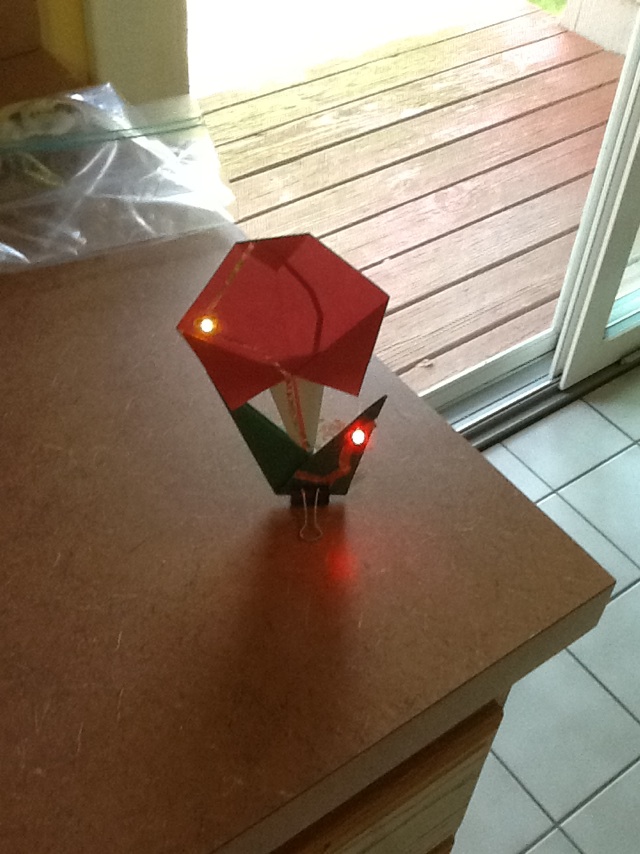
An origami rose with a parallel circuit built via circuit stickers.
Our semester themed project for CEP811 was to create a lesson plan involving a maker kit. I chose Circuit Stickers. We had to revise the lesson plan twice throughout the course as we uncovered more and more about what the maker mentality truly is. It is truly amazing to go back to previous blog posts and see the evolution of this project. What started out as a means to a grade quickly turned to a research-based plan that has had most aspects revised to meet the needs of all of my students. What if every lesson plan or project had this much thought and research involved? How amazing would it be if we could create hands on activities that motivated and excited learners AND gave them all the necessary skills to pass tests and be successful in their future work environment.
This portion of the class changed how I viewed curriculum design. Where before I was focused on content I now focus on how to get that content to students in a way that is meaningful to them. I was also very concerned about the creativity portion of this project. How could I, a not-so-creative person, make something memorable? This question in itself has changed. As teachers we all adapt. Every day we repurpose things to fit our needs. This is a form of creativity. It is also a really great skill.
Recall my ideal classroom:
My ideal classroom. Created via SketchUp.
Another thing we looked at this year was layout. No, I do not have all the furniture shown above, but I do have furniture I can repurpose to fit this classroom design at a very low budget. As this article on project based learning states, “How we introduce the project to students is much more important than we thought (and we thought it was very important).” Therefore, how we set up our work space truly does speak to students and help set expectations.
Will I implement what I have learned in CEP811? Most definitely. I learned that I am able to repurpose nearly anything to have a practical purpose. I learned how to set up my classroom into a maker space and why it is important to do so. I also learned a great way to hold professional development.
The last thing we really focused on was edcamp, an unconference experience. As this lesson occurred just last week you can read all about my experience with an unconference and how it has forever changed the way I will view and evaluate PD in the previous post of this blog.
Overall, this has been an excellent experience and great use of my time. I feel that the things I have learned in CEP811 will forever change the way I implement lessons in my classroom and the things i advocate among my peers.